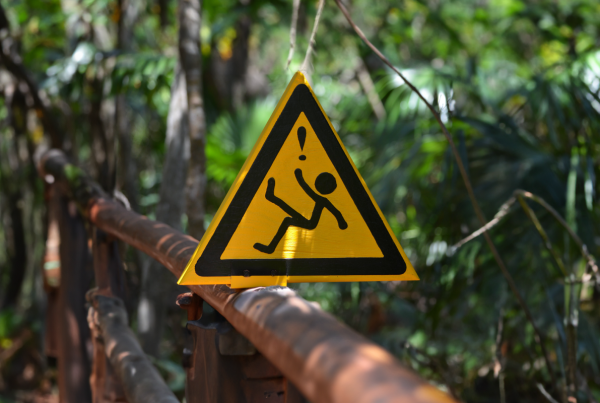
A slip and fall accident can happen in a grocery store, restaurant, shopping center, apartment complex, or other property. When a fall results in an injury, one of the first questions people may have is how to prove who was responsible. Understanding how liability works in a slip and fall accident can help people recognize what evidence may be relevant and why the circumstances surrounding a fall matter.
In California, proving liability in a slip and fall accident generally requires showing that a property owner or another responsible party failed to use reasonable care to maintain the property or address a dangerous condition, and that this failure contributed to the injury. However, liability depends on the specific facts of the incident, the applicable law, and the available evidence. A fall alone does not automatically establish that a property owner is legally responsible.
What Does Liability Mean in a Slip and Fall Accident?
Liability refers to legal responsibility for an injury or loss. In a slip and fall case, liability often involves premises liability, a legal concept that addresses certain injuries caused by dangerous conditions on someone else’s property.
Property owners and others who control or maintain property may have a duty to use reasonable care to keep the premises reasonably safe. Depending on the circumstances, this may include inspecting the property, repairing hazards, cleaning spills, providing adequate warnings, or taking other reasonable steps to address unsafe conditions.
Examples of potentially hazardous conditions include:
- Wet or slippery floors without adequate warnings.
- Spilled food, drinks, or other substances in walkways.
- Uneven flooring, loose tiles, or damaged carpeting.
- Broken stairs, missing handrails, or deteriorating steps.
- Cracked sidewalks or uneven walking surfaces.
- Poor lighting that makes hazards difficult to see.
- Objects, debris, or other obstructions left in pedestrian pathways.
The presence of a hazard does not automatically establish liability. Evidence must help explain what caused the fall, whether the responsible party failed to meet an applicable duty of care, and whether that failure caused or contributed to the injury.
What Must Be Proven in a Slip and Fall Case?
Although the precise legal requirements depend on the circumstances, several elements commonly matter when evaluating a California premises liability claim.
1- A Duty of Care Existed
The first consideration is whether the property owner or another responsible party had a legal duty to use reasonable care under the circumstances.
For example, a business open to customers generally must take reasonable steps to maintain safe premises. A landlord, property manager, maintenance company, or other party may also have responsibilities depending on the property, the condition involved, and the applicable agreements and laws.
Determining who had responsibility for a particular hazard may require examining who controlled the area, who maintained it, and who was responsible for inspections or repairs.
2- A Dangerous Condition Existed
Evidence must help establish the condition that caused the fall. This may be a liquid spill, damaged floor covering, broken step, uneven pavement, or another hazardous condition.
Photographs and videos can be especially useful because property conditions may change quickly. A spill might be cleaned, a warning sign might be moved, or a damaged surface might be repaired shortly after an incident.
Photographs taken near the time of the fall may help document the condition, its location, the surrounding area, and any visible warning signs. Incident reports, maintenance records, inspection logs, and repair records may also provide relevant information.
3- The Responsible Party Knew or Should Have Known About the Hazard, or Failed to Use Reasonable Care
Notice is often an important issue in slip and fall cases. In California, evidence may need to establish that the responsible party created the dangerous condition, actually knew about it, or should have discovered it through reasonable care.
Actual notice means the responsible party knew about the condition. For example, an employee may have received a report about a spill before someone fell.
Constructive notice generally means the condition existed long enough, or was sufficiently apparent under the circumstances, that a reasonably careful property owner or responsible party should have discovered it.
For instance, a spill that remained on a store floor for an extended period may raise questions about inspection procedures and whether employees had a reasonable opportunity to discover and address it. Evidence that a hazard was created by an employee or another representative of the business may also be relevant.
The time a hazard existed is not the only consideration. The nature of the condition, the location, the property’s inspection practices, and the surrounding circumstances may all affect whether reasonable care was exercised.
4- The Dangerous Condition Caused the Injury
Another important issue is causation. Evidence must connect the hazardous condition to the fall and the resulting injury.
For example, a person who slips on a wet floor may sustain a wrist fracture while trying to break the fall. Evidence of the wet floor, witness observations, incident documentation, and medical records may help establish how the incident occurred and what injuries followed.
Medical records can document the nature and extent of an injury, the treatment provided, and the symptoms reported. However, medical documentation alone may not establish why the fall occurred or whether another party was legally responsible.
A clear account of the incident, supported by available evidence, can help explain the relationship between the property condition, the fall, and the injury.
What Evidence Can Help Prove Liability?
The evidence available after a slip and fall accident can play an important role in determining whether a premises liability claim has merit. Different types of evidence may help answer different questions about the incident.
Photographs and Videos
Photographs of the hazard, surrounding floor or walkway, lighting, warning signs, and general area may help document the scene. Video footage from security cameras or other recording devices may show how the incident occurred or how long a hazard was present.
Because surveillance footage may be overwritten or deleted as part of routine operations, the availability of recordings can be time-sensitive.
Witness Statements
People who saw the fall or observed the dangerous condition beforehand may provide useful information. Witnesses might include customers, employees, maintenance personnel, or other individuals who were present.
Their observations may help establish where the hazard was located, whether warning signs were present, whether anyone reported the condition, and what happened immediately before or after the fall.
Incident Reports
A business or property manager may prepare an incident report after a fall. Such reports can document when and where the incident occurred, who was involved, and what was reported at the time.
An incident report does not automatically prove liability, but it may help preserve details that could otherwise be difficult to recall later.
Inspection and Maintenance Records
Inspection logs, cleaning schedules, maintenance records, and repair documentation may help establish how the property was maintained and whether reasonable steps were taken to identify or address hazards.
For example, cleaning records may help establish when an area was last inspected, while repair records may provide information about a previously reported flooring problem.
Medical Records and Other Documentation
Medical records, photographs of visible injuries, receipts, and documentation of missed work may help establish the consequences of a fall. These materials may be relevant to evaluating the extent of the injuries and any resulting losses.
Together, different forms of evidence can provide a more complete picture of the incident than any single document or photograph alone.
Can You Still Recover Compensation if You Were Partially at Fault?
California follows a system of pure comparative negligence. Under this system, a person’s potential recovery may be reduced by their percentage of responsibility for the incident.
For example, if a person is found to have sustained $50,000 in damages and is determined to be 20% responsible for the accident, their recovery could be reduced to $40,000. This is a simplified illustration, not a prediction of the outcome of any particular case.
Questions about a person’s awareness of a hazard, their conduct before the fall, and the visibility of the dangerous condition may be relevant when evaluating responsibility. However, a person’s actions do not necessarily eliminate the liability of another party.
The effect of comparative negligence depends on the evidence, the applicable law, and the allocation of responsibility.
What Should You Do After a Slip and Fall Accident?
The steps taken after a fall may help preserve important information about the incident.
When reasonably possible, a person involved in a slip and fall may consider documenting the scene, identifying witnesses, reporting the incident to the property owner or manager, and keeping copies of relevant records. Seeking appropriate medical evaluation can also help document injuries and identify treatment needs.
It may be useful to retain photographs, correspondence, incident reports, medical records, and other materials related to the event. If surveillance footage or other evidence may exist, its preservation could be important.
Deadlines may apply to premises liability claims, and certain cases involving government entities may have different, shorter claim requirements. The applicable deadline depends on the circumstances, so delaying the evaluation of a potential claim can affect the ability to pursue it.
How Fielding Law Can Help Explain Slip and Fall Liability
Understanding liability after a slip and fall accident often requires looking beyond the fact that a person fell. The condition of the property, the responsible party’s knowledge of the hazard, the steps taken to address it, and the evidence connecting the condition to the injury can all matter.
Fielding Law represents people injured in accidents involving negligence and other potentially actionable conduct. The firm approaches client representation with an emphasis on integrity, thoughtful guidance, and the individual circumstances of each case.
People who have questions about a potential slip and fall claim can contact Fielding Law to discuss their situation and learn more about their options. A consultation can provide an opportunity to ask questions and better understand the factors that may affect a potential claim.
Fielding Law offers Free consultations, with no obligation, and is available 24/7. Call 833.88.SHARK to learn more.
Fielding Law, APC – Irvine, CA Office
505 Technology Dr Ste 250
Irvine, CA 92618
(949) 288-5484
Fielding Law, APC – Phoenix, AZ Office
2 N Central Ave Ste 1800
Phoenix, AZ 85004
(859) 578-4444
Note: Information provided is for educational purposes and does not constitute legal advice. Always consult with a qualified attorney for legal concerns.